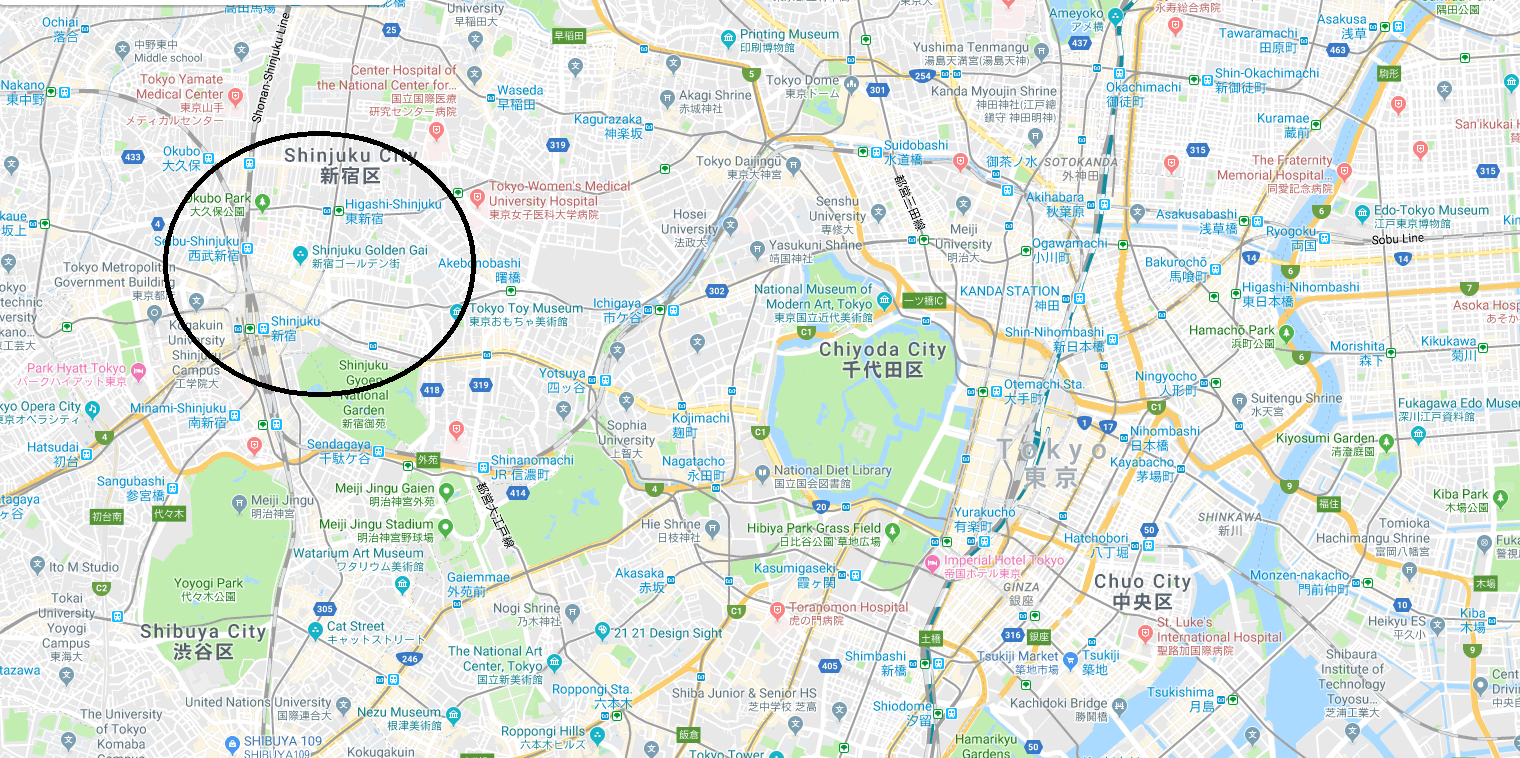
Location: 5 minute walk from East Exit of JR Shinjuku Station
This is a red light district! Don’t take children here! The area also has pushy people trying to get you to go into a club, bar, etc.. However, if you are curious and 20+ of age, you can find love hotels, nightclubs, and more.
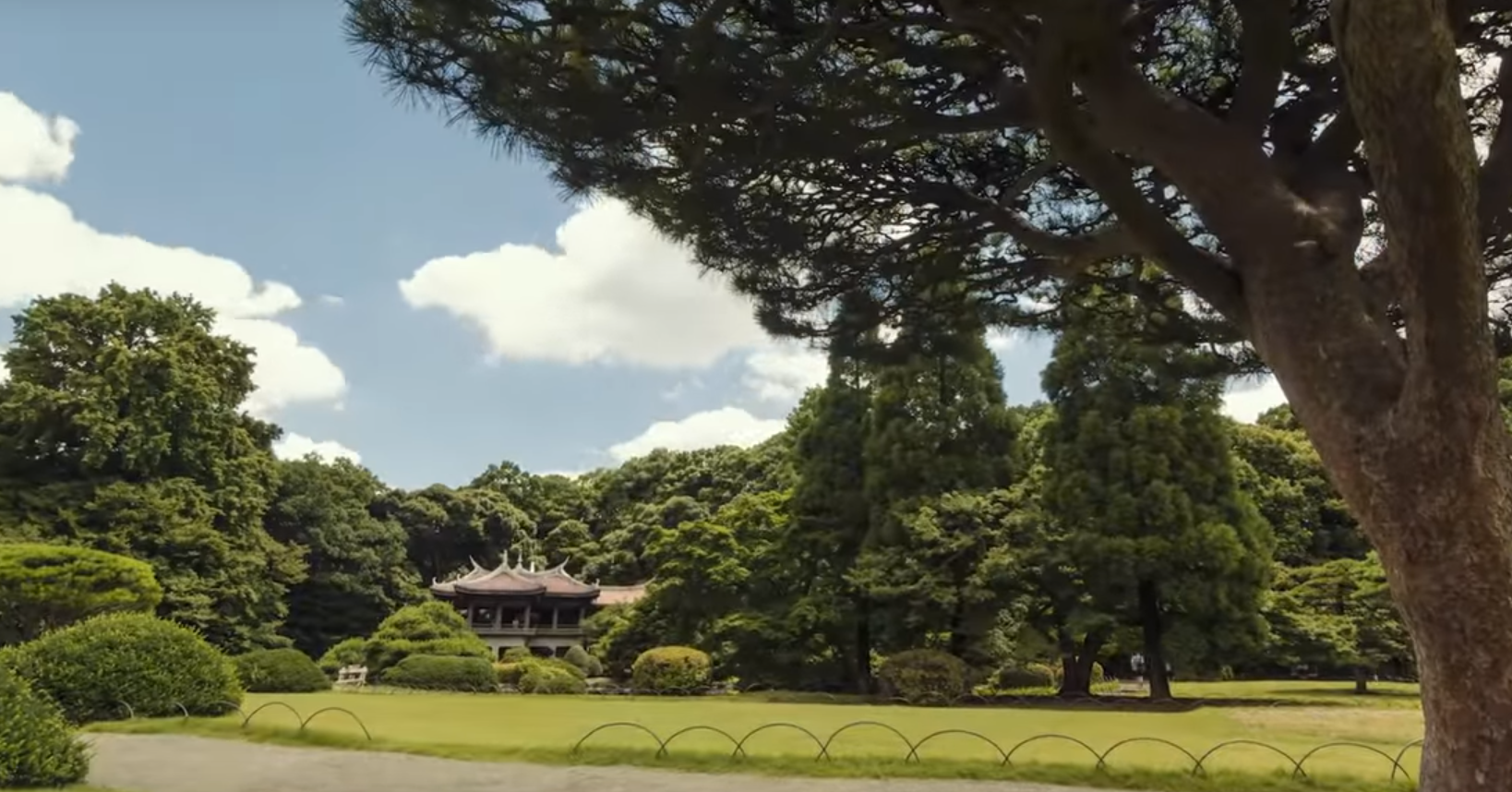
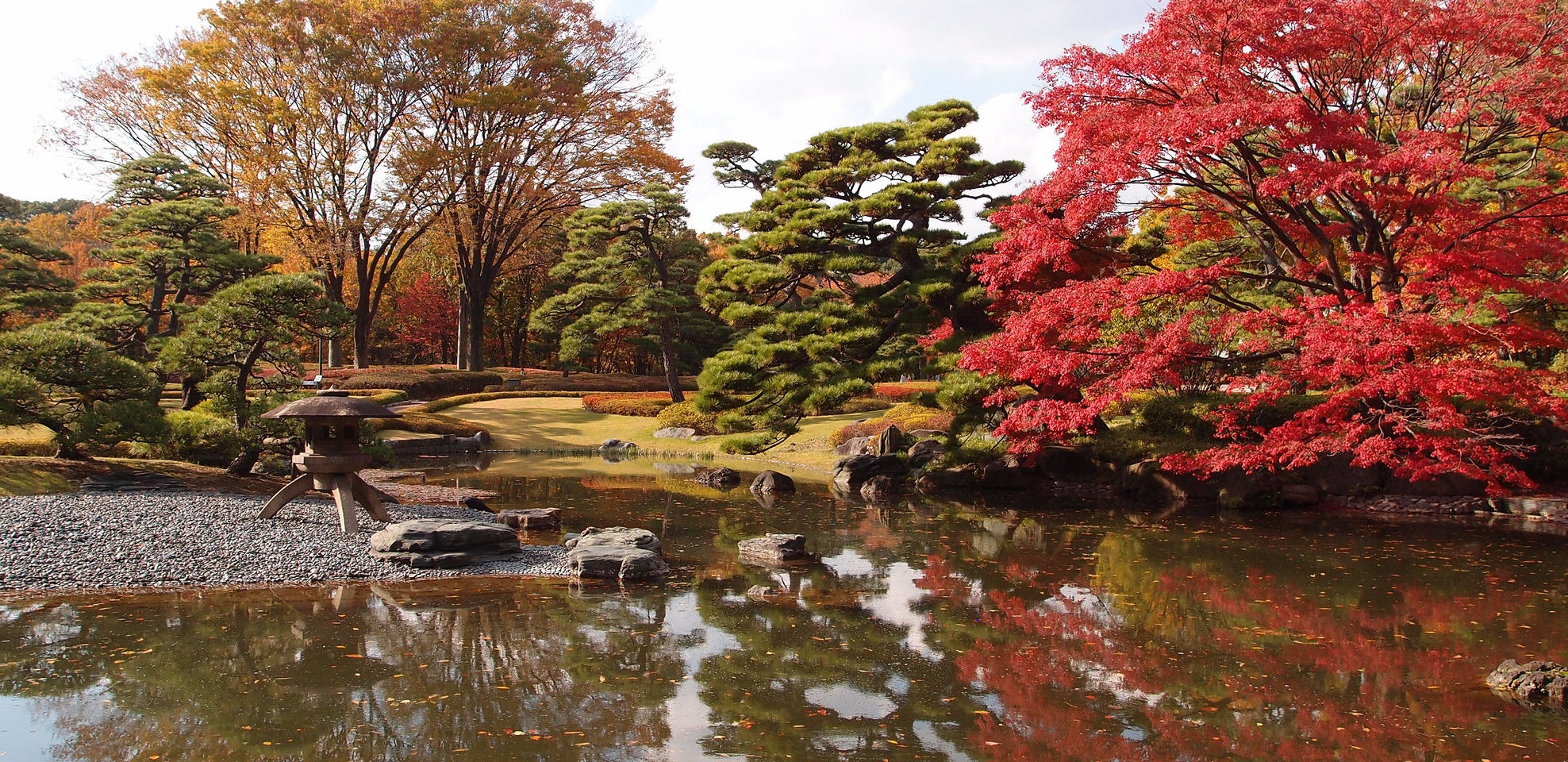
Chill at this garden in Shinjuku! Even picnic if you want!
Diverse Food
There are a lot of izakayas here and there are locations where you can get food that isn’t Japanese if you need an American, Italian, Chinese, etc. food change.
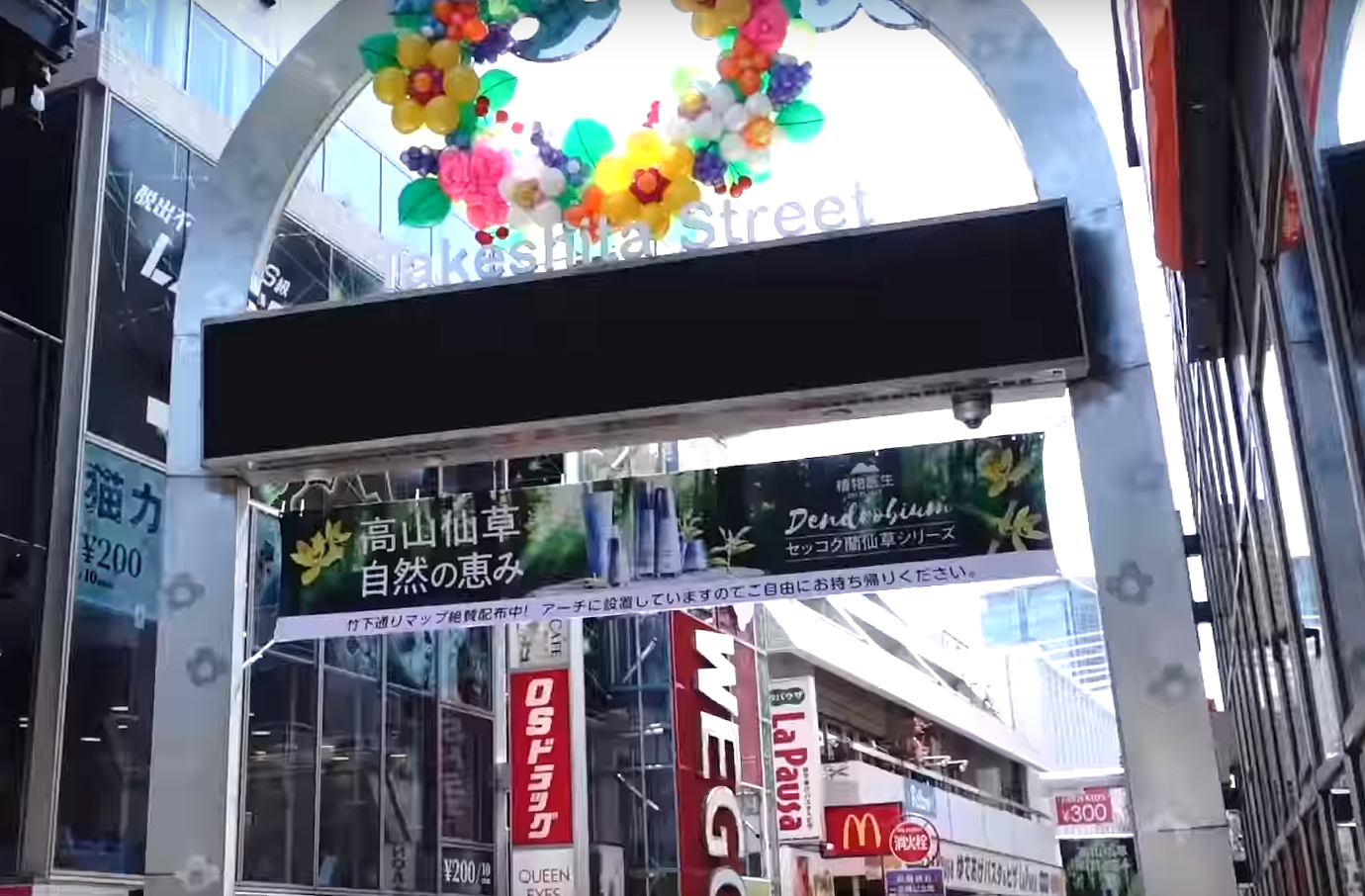
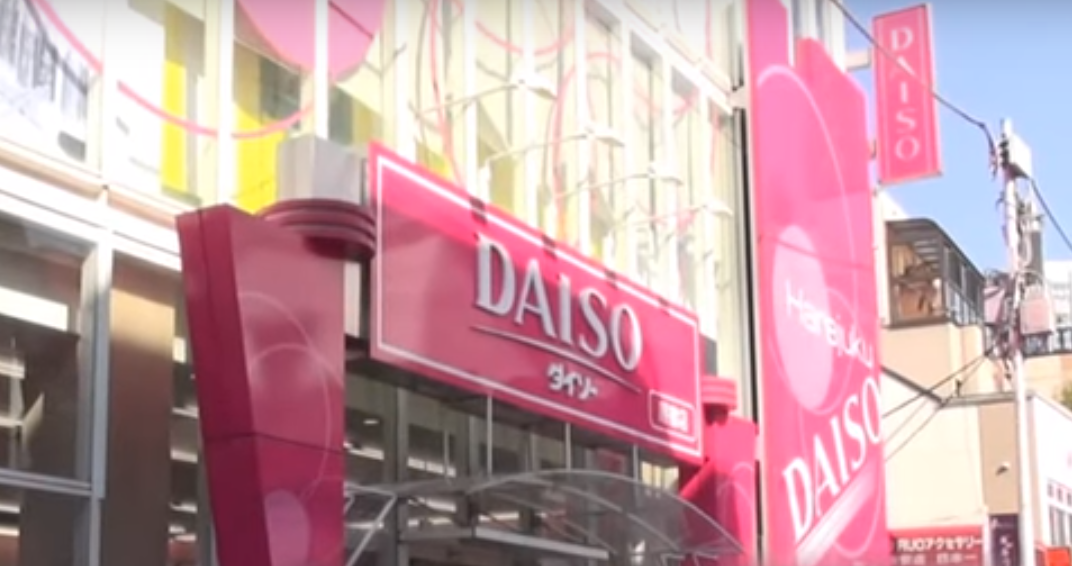
Just explore the entirety of the this street!!! There is so much street food! You can get cute ice cream, lovely crepes, giant cotton candy, and more. There are also places to get stickers, nonsensical English translated T-shirts, makeup, clothes, and more! There are themed cafes on/near this street as well.
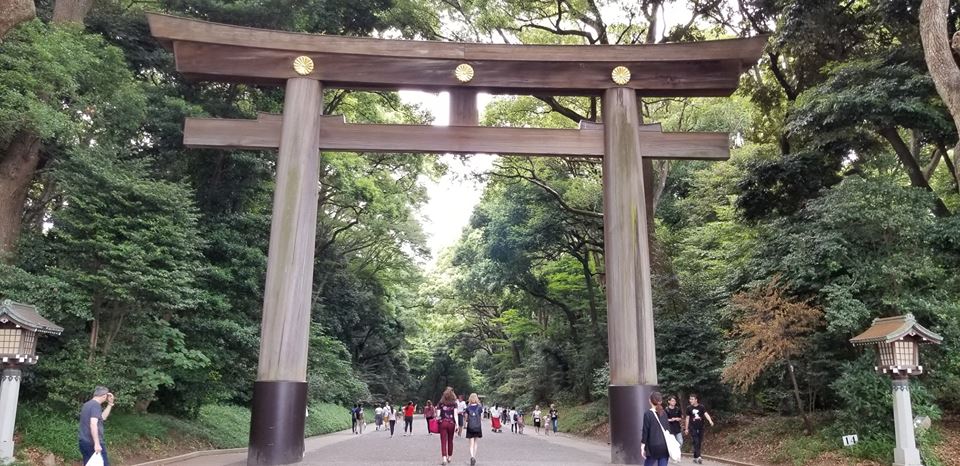
Meiji Shrine and Yoyogi park are near Takeshita street. Experience hearing the city to complete sounds of nature as you travel into the shrine or inner park.
This plaza (ometsando harajuku) is another place to shop if you don’t want to buy expensive things at Ginza or Roppongi. Also there are plenty of stores around this area, just walk around.
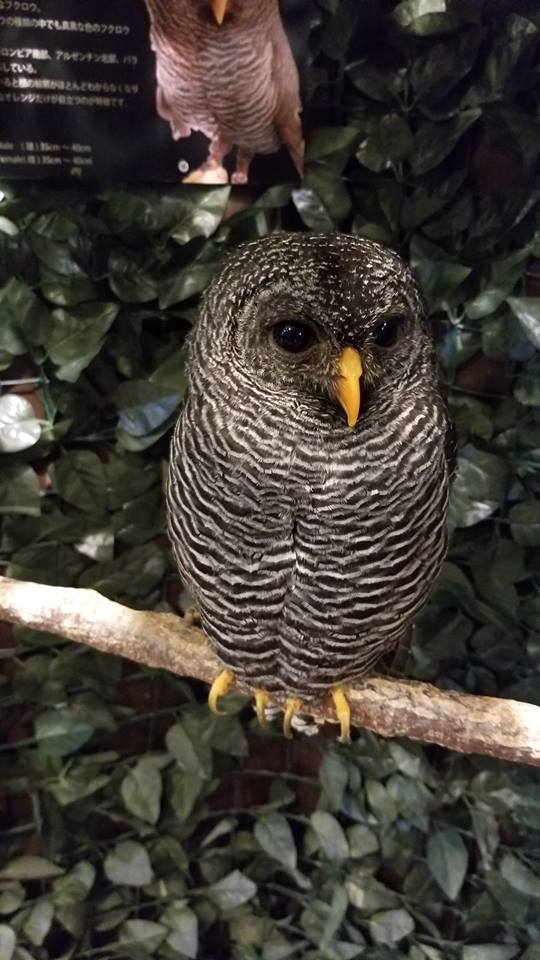
Before you decide to go to an animal themed cafe, look up locations before heading to Harajuku. Many of these places require reservations: some websites are English friendly where you can book yourself a spot, or there are service areas near Takeshita Street who can book for you!
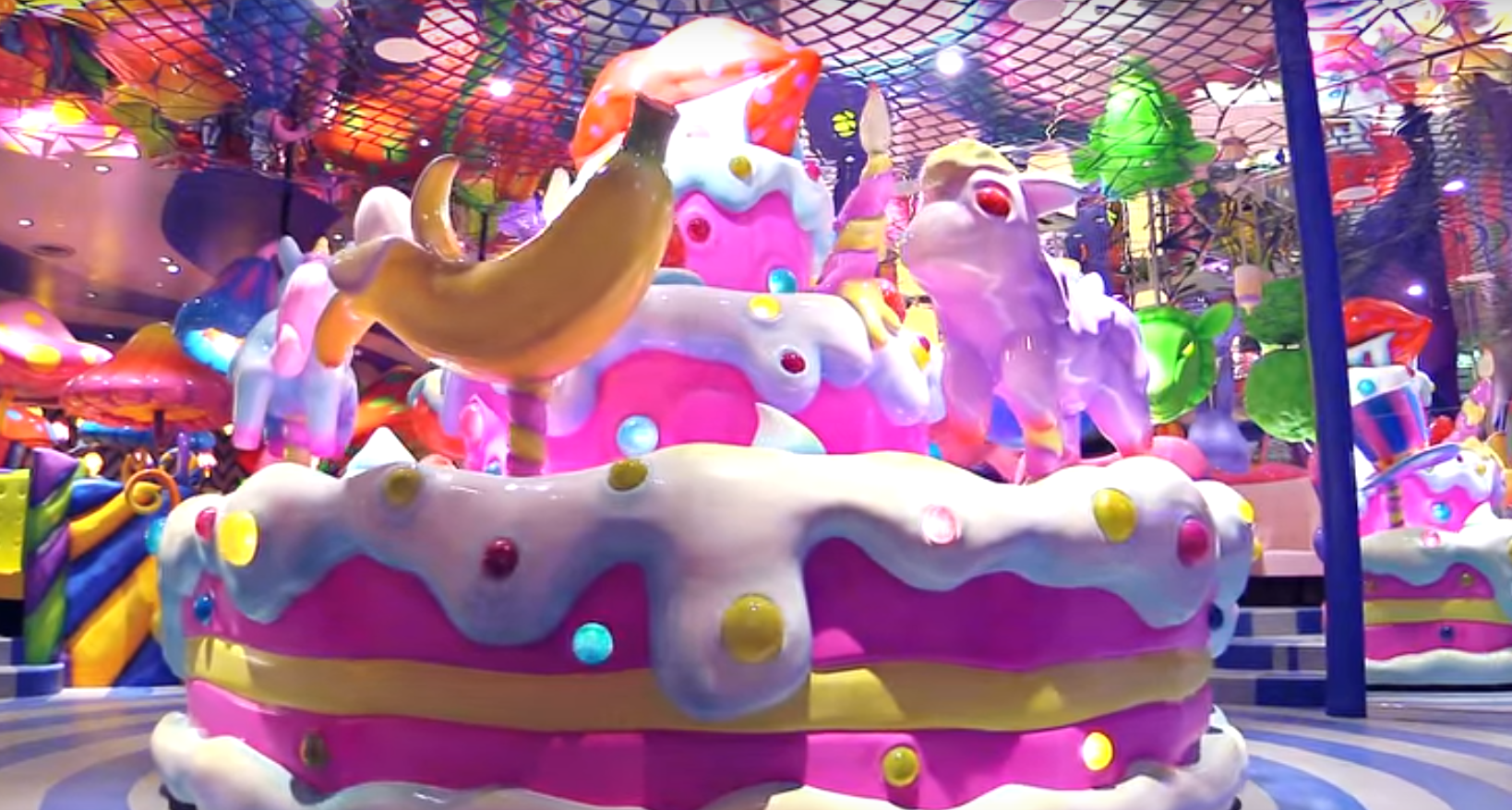
If you have plenty of time or just lucky (usually a long waiting line outside), head to Kawaii Monster Cafe! Super cute experience that are photo worthy! Also you can order on a tablet.
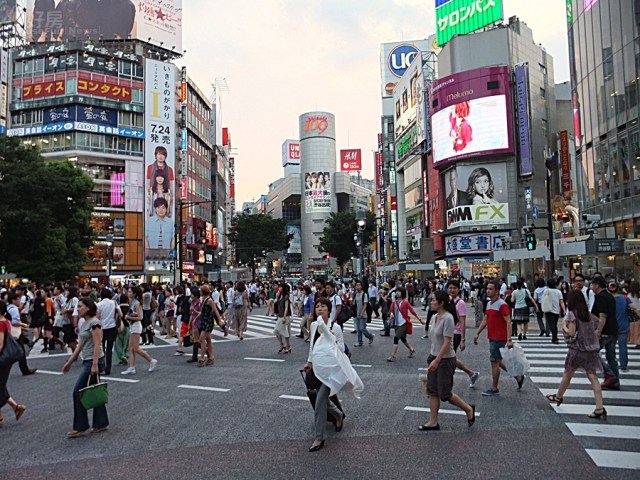
Probably one of Tokyo’s famous streets where all pedestrians
from all directions cross at once. Be quick though, the lights don’t last too
long if you wanted a photo.
I know Shibuya for its izakaya. There is so many and I haven’t found one where it was bad, so if you see one, head in. I am personally not recommending a spot simply because I just walk into places and hope for the best. Haven’t gone wrong yet though. If you are uncertain, ask the person at the “front desk” if you can see an English menu or if the menu has pictures (“suimasen, eigo no menu ga arimasuka” Or “suimasen, menu wa tabemono no shashin ga arimasuka”)
Please understand that Japanese people often smoke at pubs which is what an Izakaya is.
I love Asakasa (not Asakusa) for its food! Walk into many of its backstreets and you will see many capsule hotels, restaurants stacked on top of each other (up and down/right and left), and more. I recommend coming here for other things too, but mainly for dinner experiences.
Akasaka is close to Roppongi and Tokyo Skytree, so you can combine this place to your itinerary. Here is some of my recommendation for you!
To be honest, it’s not the best Yakiniku place, but you can
make reservations online (and in English) and do all you can eat/drink cheaply
for 2 hours! Toraji is also a chain you can find elsewhere, but I like the vibe
of Asakasa, so I always pick here.
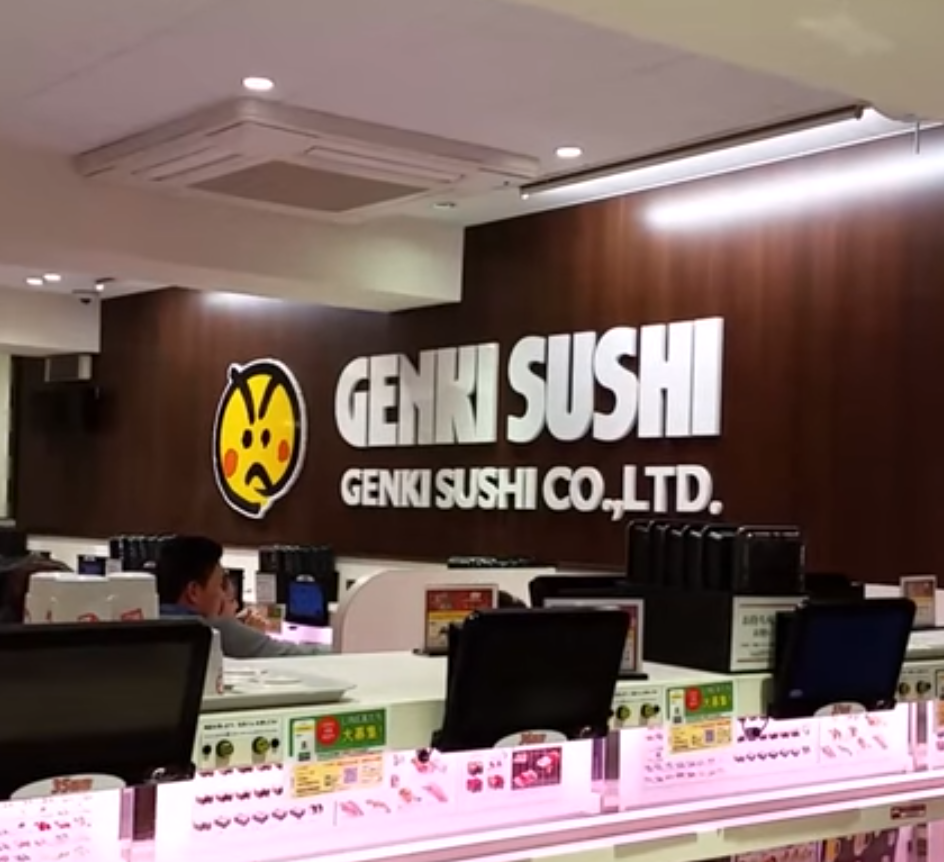
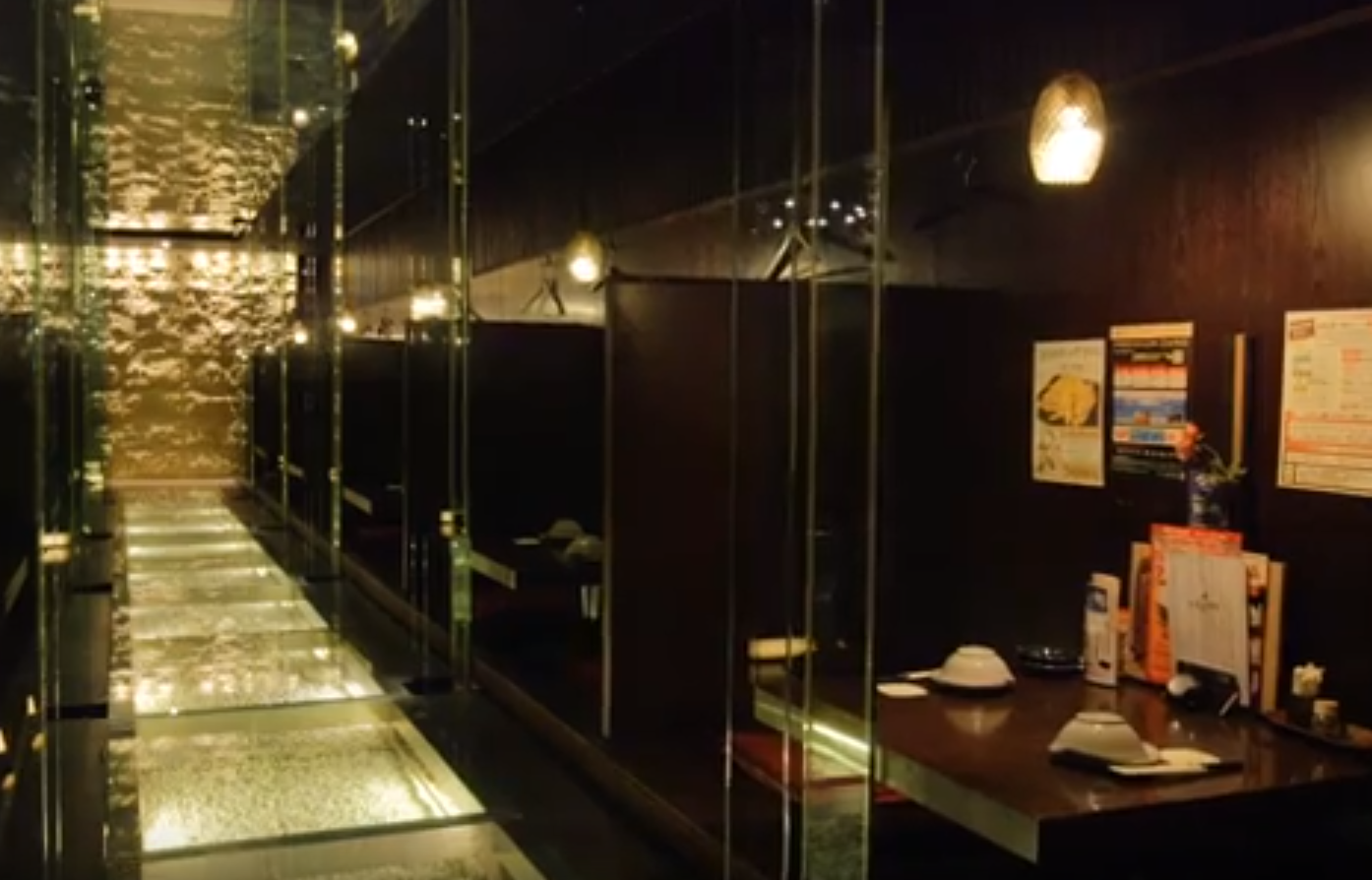
This sushi place is more on
the expensive side however, it is a foreigner-friendly establishment! You can
use google to reserve a spot for your group as well. Sushi is pretty good, and
the vibe/interior is great!
If you are a little sick of eating Japanese, head to Bistro
Q, a French restaurant. This restaurant also serves course meals as well if you
want to dine fully. You may also reserve a table online via google.
Why not eat with Ninjas! It is a little corny but it is fun
for family and friends. Food is not bad either. I recommend you reserve a spot
on their website. Because it is a dinner and a show, it is more expensive per
person.
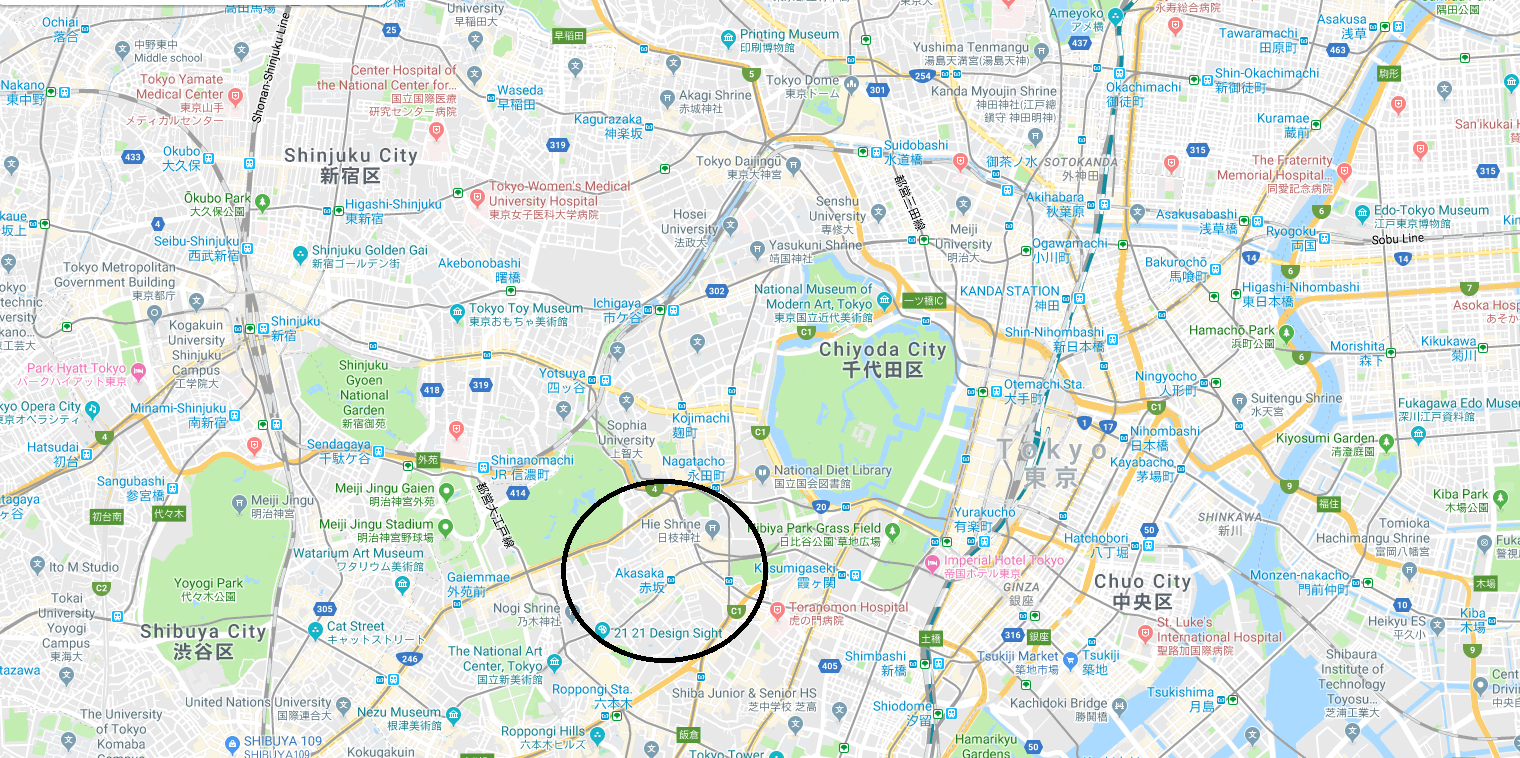
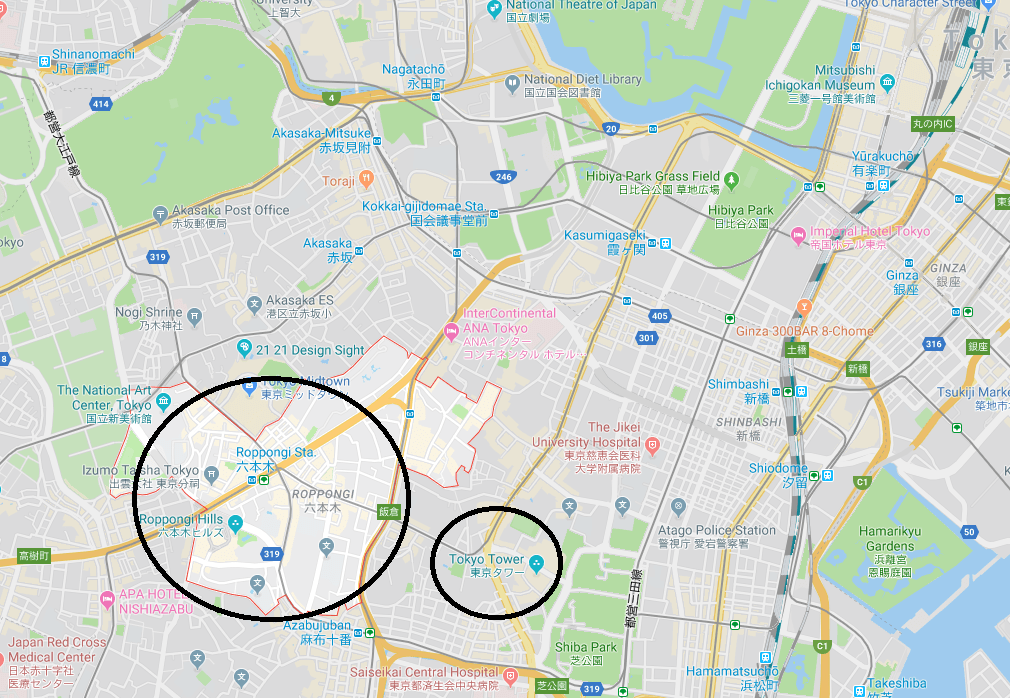
Similar to Ginza, Roppongi has high end shopping/eating. I personally call Roppongi the “Beverly Hills” of Japan. If you are looking for a more western vibe, this is a place to be in. You can also find more diverse food options here as well that are more difficult to find elsewhere in Tokyo.
What to do at Roppongi
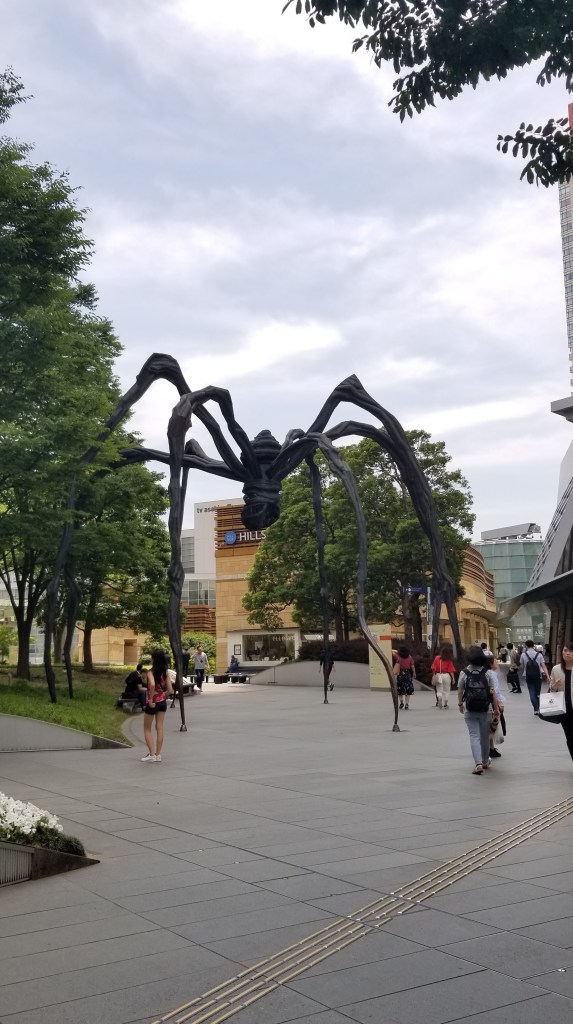
Roppongi Hills/ Mori Garden/ Maman/ Mori Art Museum
Explore Roppongi Hills and it’s over 100 shops/restaurants inside the center. (You may get lost in the building haha). Outside of Roppongi Hills is the Mori Garden and Maman. It’s a nice outdoor stroll area to relax and take iconic photos. Next to Roppongi Hills is the Mori Art museum which is within Mori Tower and has pretty interesting contemporary art!
Visit Tokyo Tower not too far away! Depending on the season, there are different exhibitions, events, attrations, and illumination within the tower. I do recommend going to the tower at night since its a better view of Tokyo and the Tower.
Explore Roppongi’s show-pub! Reserve tickets online and watch a show containing Kabuki actors/dancers to transsexual dancers. Food can be ordered to enjoy the show from bento boxes to dinner courses!
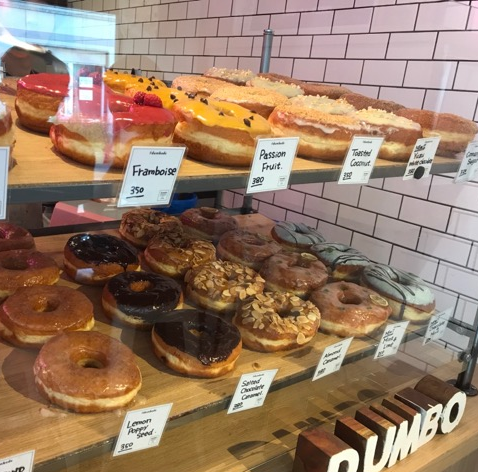
Try this Donuts place where matcha icing donuts are a thing! Loved this place more than Mr.Donuts, and the donuts are very fluffy but not overly sweet.
If you like Dragon Quest, then this Izakaya is for you! Order faces of popular characters and enjoy a meal.
Information regarding clubs/bars in Roppongi:
I don’t recommend any clubs in Roppongi. There are better ones in other places. Unless you are Japanese, most clubs in Roppongi will pressure you hard to go into clubs and spend a lot of money on drinks. Some of the clubs are a little sketchy if you don’t know anyone who can speak Japanese for you. I knew places that would pressure underage foreigners to go into their club.
As for bars, many bars you go to will have a seating charge (pay to just sit in) for about 15 dollars and up. Then the beers and drinks are also expensive. So I recommend going to a bar in a small/least popular district or neighborhood.
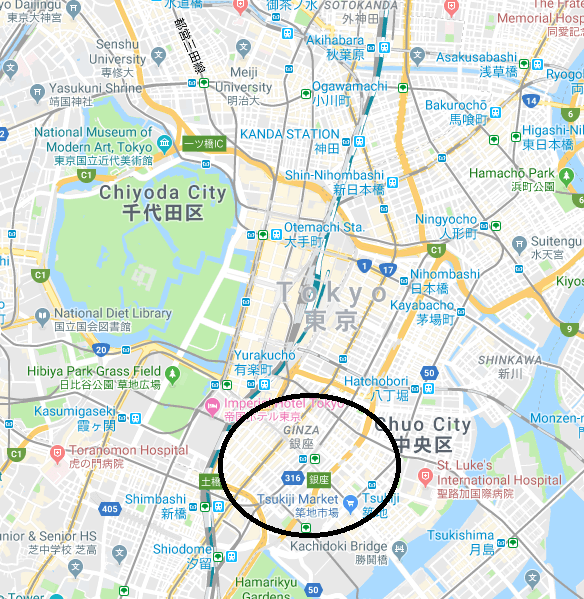
Ginza is popular for high end restaurants and shopping experience. So if you are looking for a place to do some nice shopping, this is the area you should be in (other than Roppongi). If you don’t plan on spending much money, there are also some budget experiences there as well.
Many other blogs will recommend you to go eat really high-end sushi, bars, restaurants ($30-up). However, I personally don’t recommend this. There are places that have great/cheaper fresh sushi and restaurants that are within the 15-25 dollar range. To pay high prices for a couple pieces of sushi/food here and there, and then wait in long lines is not worth it for a traveler who is on a budget, on a schedule, and, probably not coming back to Japan for a while. So these places are my personal recommendation if you have time/money.
If you have never experienced watching a kabuki play, I recommend it (please know that some shows are very long and you can get a device to read/watch play in English).
This street is lined with many shops (boutique, department, etc). This street is popular for tourists and locals! It is also a great place to see and go to at night.
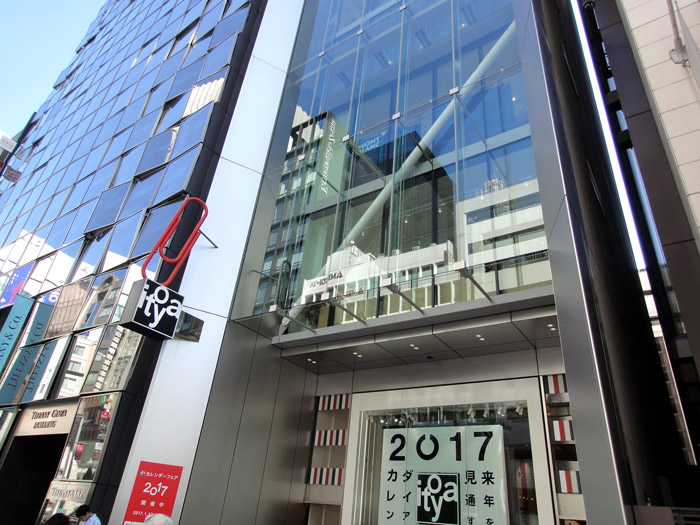
If you are still part of the culture of handwriting letters, notes, and more, then head to Ito-ya. It’s a store offering varieties of stationary, writing utensils, and much much more!
Pretty neat bar that also caters to foreigners! There is also food too if you are out late at night (that also doesn’t kill your bank account).
Tip: If you are going to eat at Ginza, I recommend you just splurge a little. Most restaurants you come across can have meals from $15-up per person. If you want something on the cheaper end, then buy from stalls, convenience stores, or cafes. But if you are already here to spend money, then might as well spend a little more at these restaurants rather then hold off right? Ginza restaurants are pretty good compared to other ones in other shopping districts.
Also Tsukiji Fish Market has moved to another location! It is not near Ginza anymore.
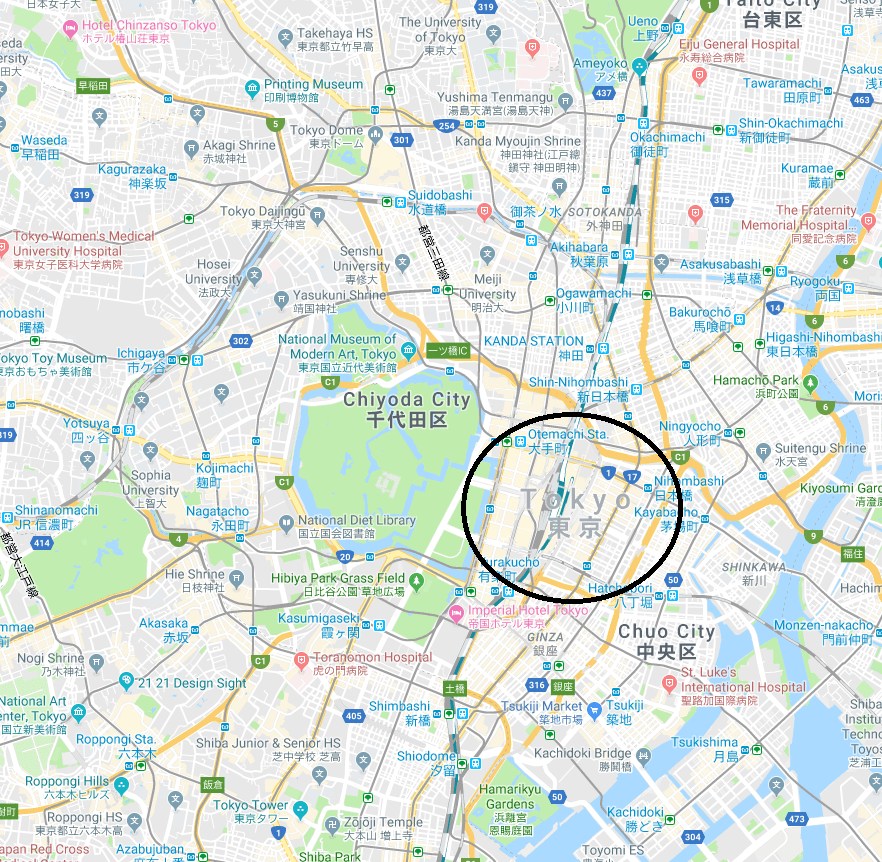
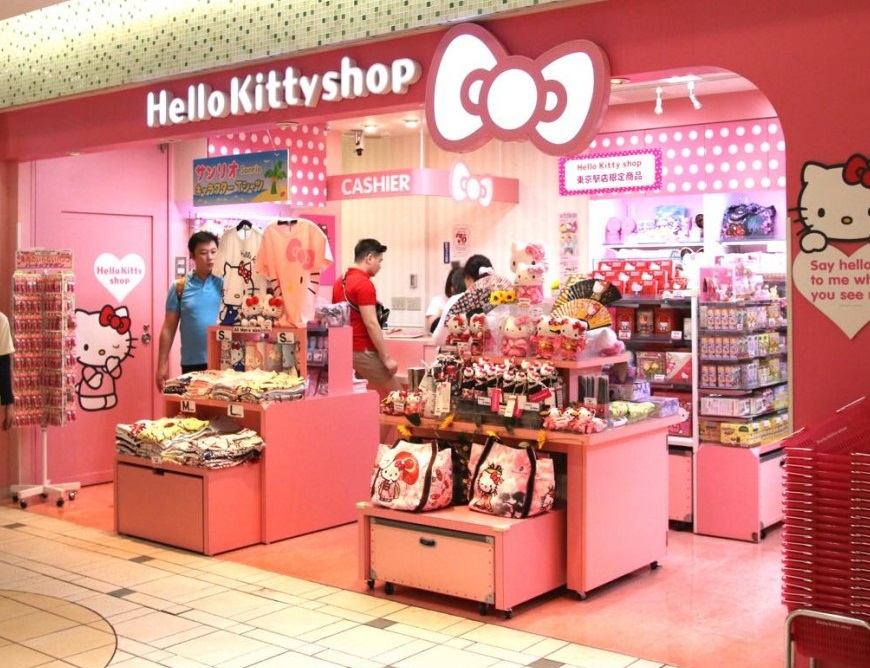
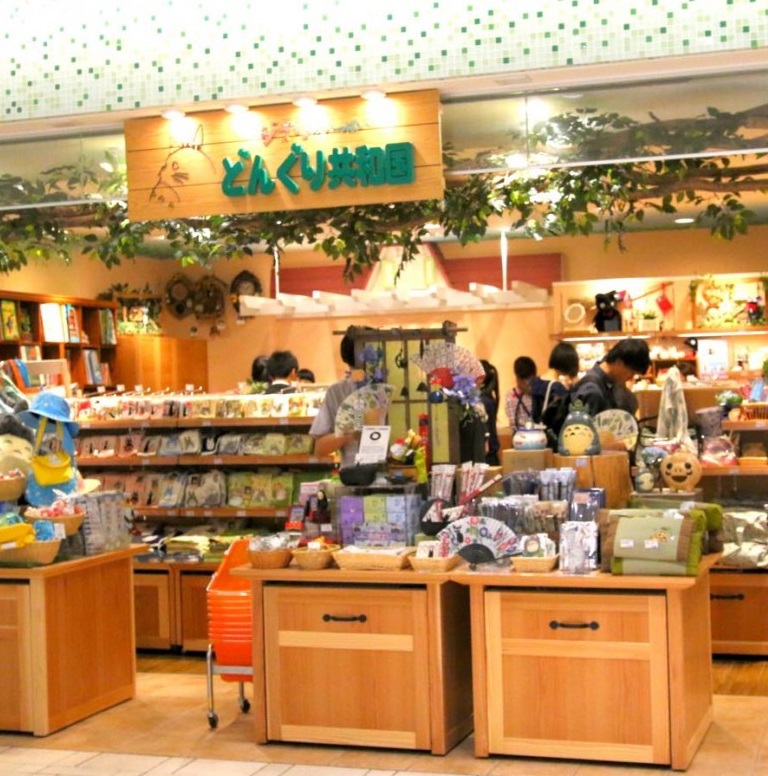
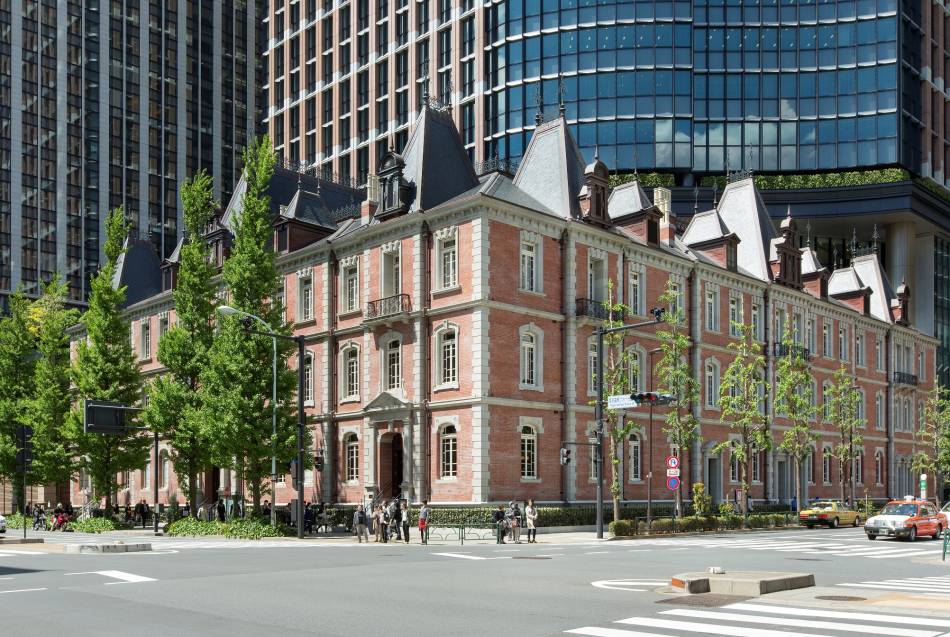
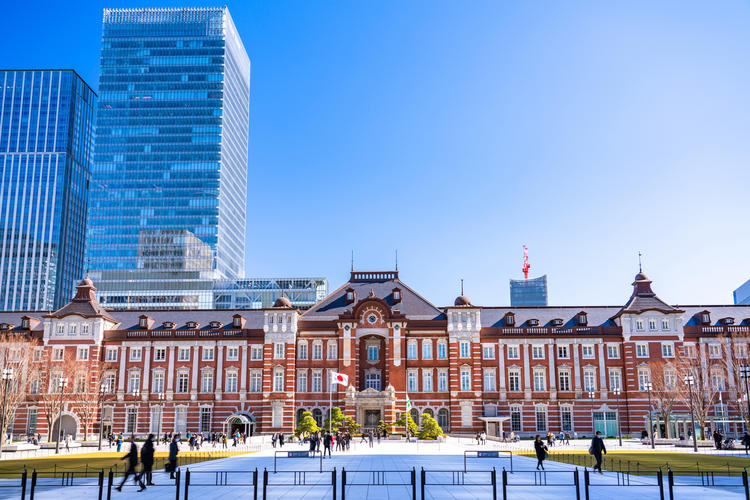
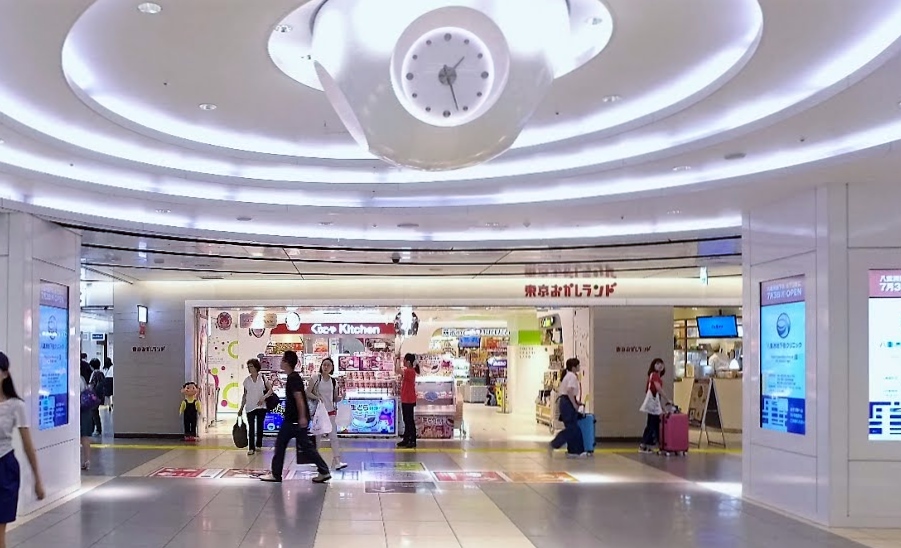
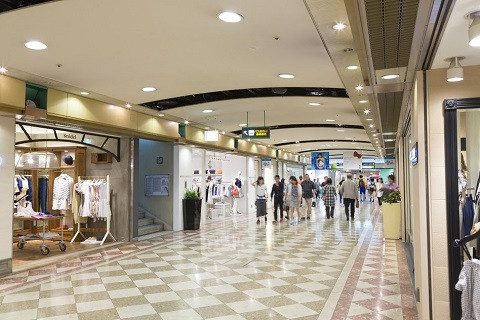
There are so many things to do in Tokyo in general. Every street or corner within the main city can be a great experience. Most little shops and restaurants are family owned so you can’t often go wrong just walking into any shop. But if you are at Tokyo Station, check out this area!
If you have luggage and can’t take it to your destination yet, NO WORRIES!
There are many lockers in the station you can rent via suica! (what is suica? check it out on this post). You can even check online to see where the locker is and if it is available http://www.tokyostationcity.com/en/information/locker.html
If for some reason you can’t find a locker to fit your bag size, head over to JR EAST Travel Service Center Baggage Storage (1F Marunouchi North Gate) or Sagawa’s Tokyo Service Center (near Nihonbash-guchi Exit of Tokyo Station). The price to temporarily store your bag is very cheap!
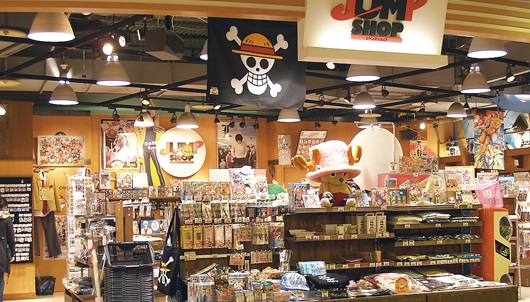
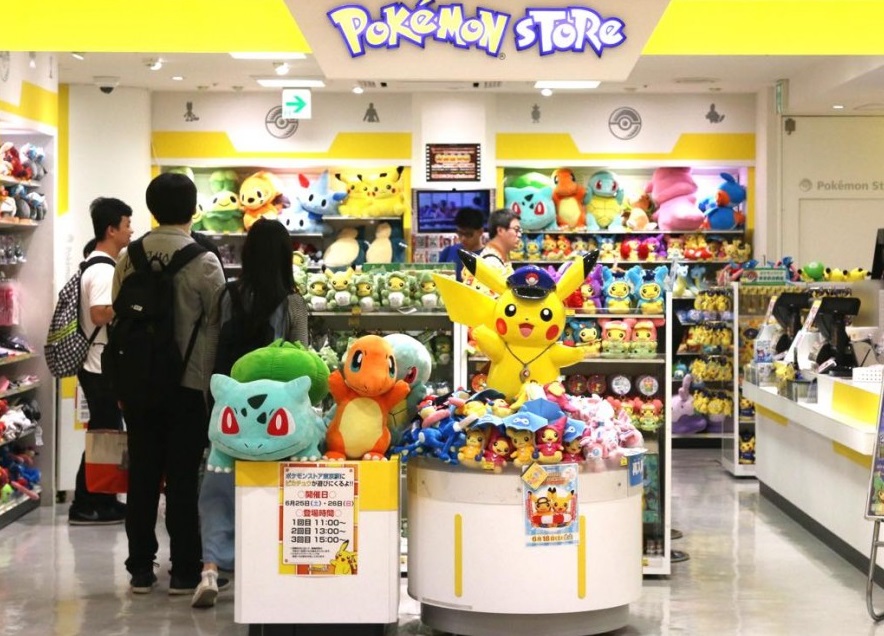
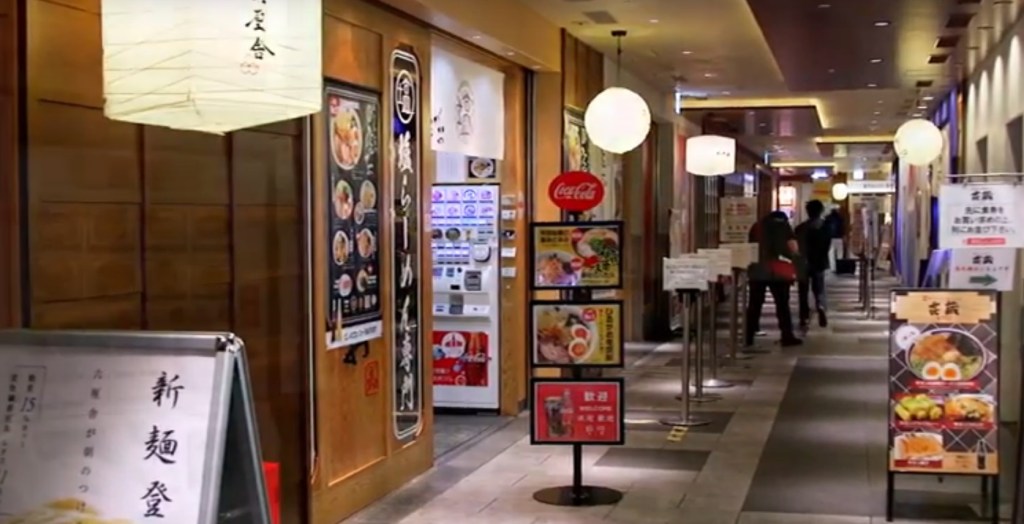
If you are a Ramen lover then head to ramen street near Character Street and try any one of the 8 lovely ramen shops there! (Caution: lines can be very long)
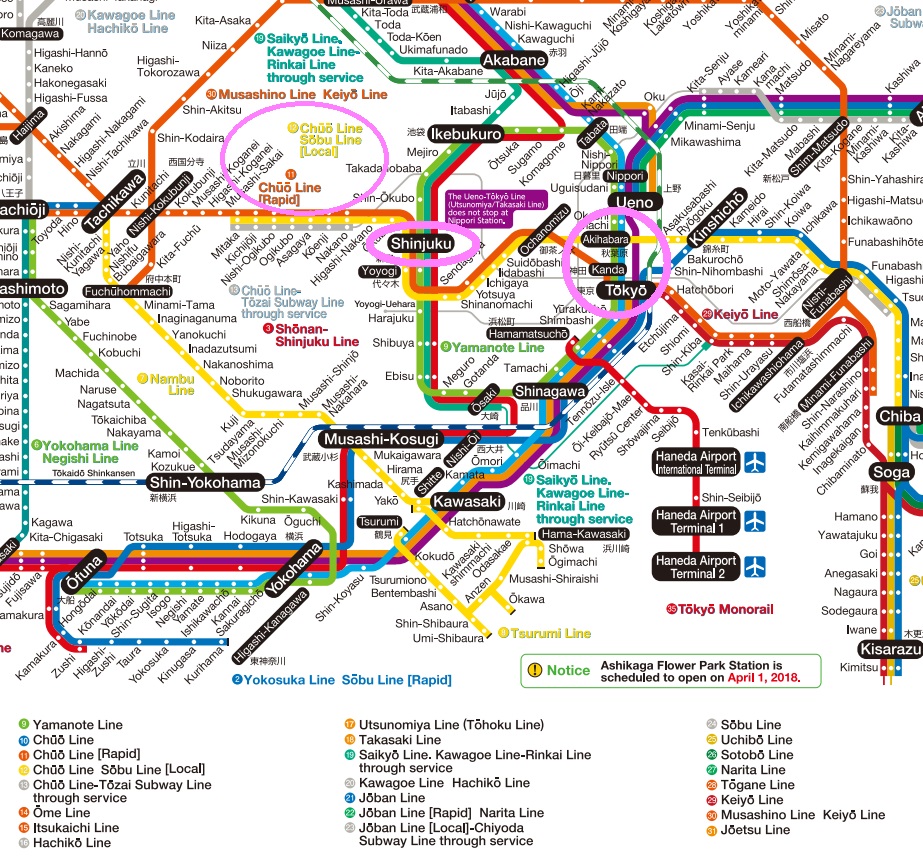
Looks like craziness doesn’t
it! Well let’s break it down!
Every colored
line is a different train line (for example the darker yellow line is the
Chuo/Sobu line)
Every black block
is a bigger or main station
Every white dot
is a smaller station that each line stops at
Let’s do an example:
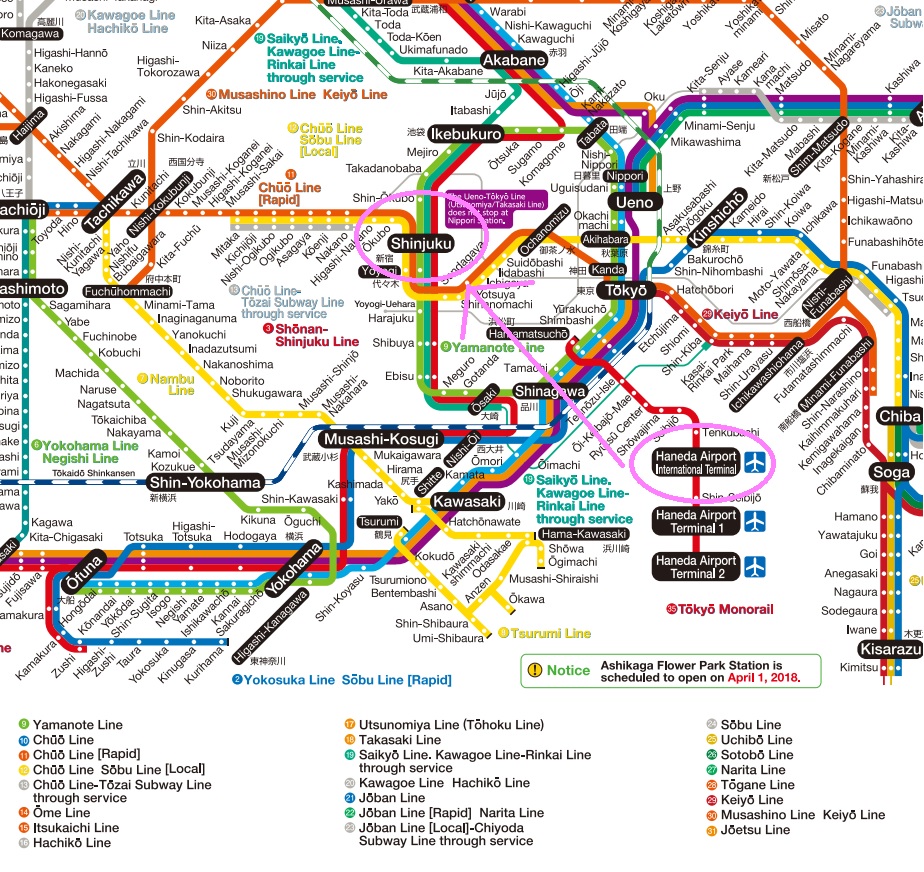
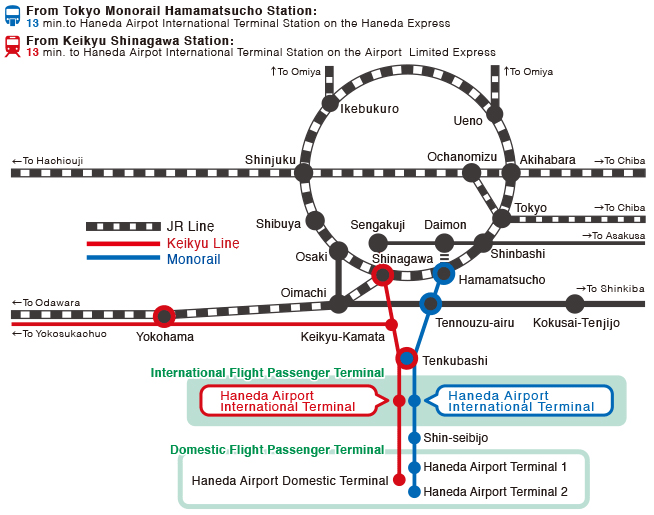
Let’s pretend you want to get from Haneda international terminal to Shinjuku station!
Please Zoom In To See!
Looking at the map, the
easiest way to get to Shinjuku is if you go to tokyo and transfer lines.
1) Start by following the
lines, you will start on the red line that says Tokyo monorail
2) From Haneda international
terminal, it will take 7 stops to get to
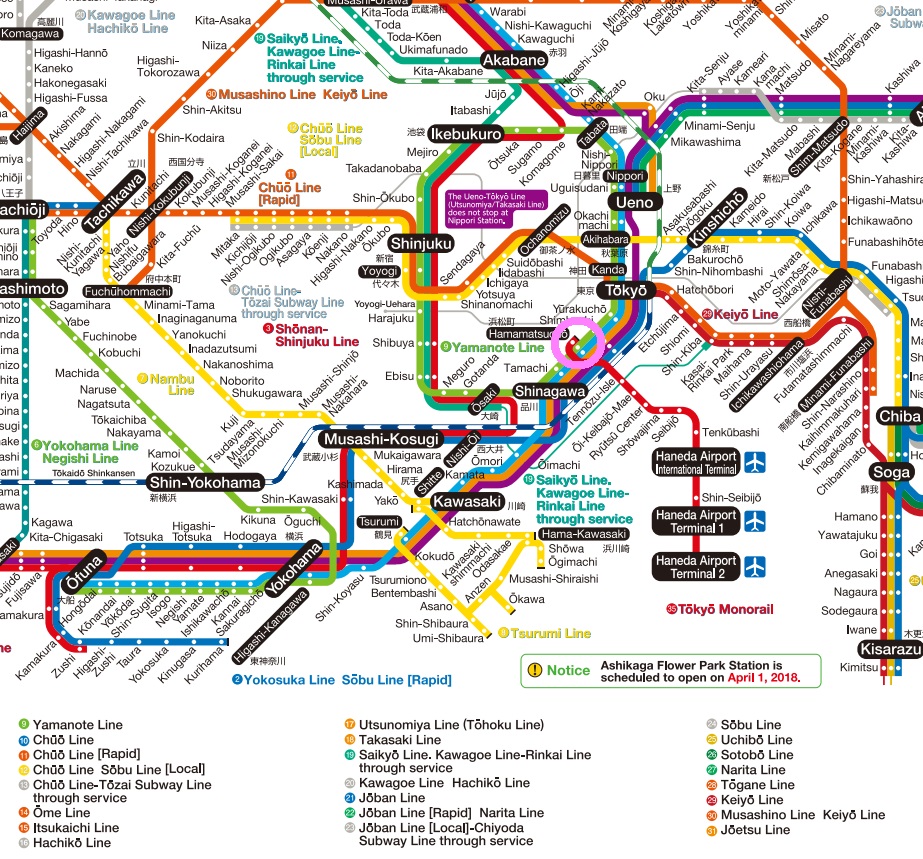
Hamamatsucho
3) (as you can see there are
3 lines that stop at Hamamatsucho since there are 3 dots)
4) From Hamamatsucho, you can transfer to either the Yamanote line (light green) or the Keihin-Tohoku line (light blue)
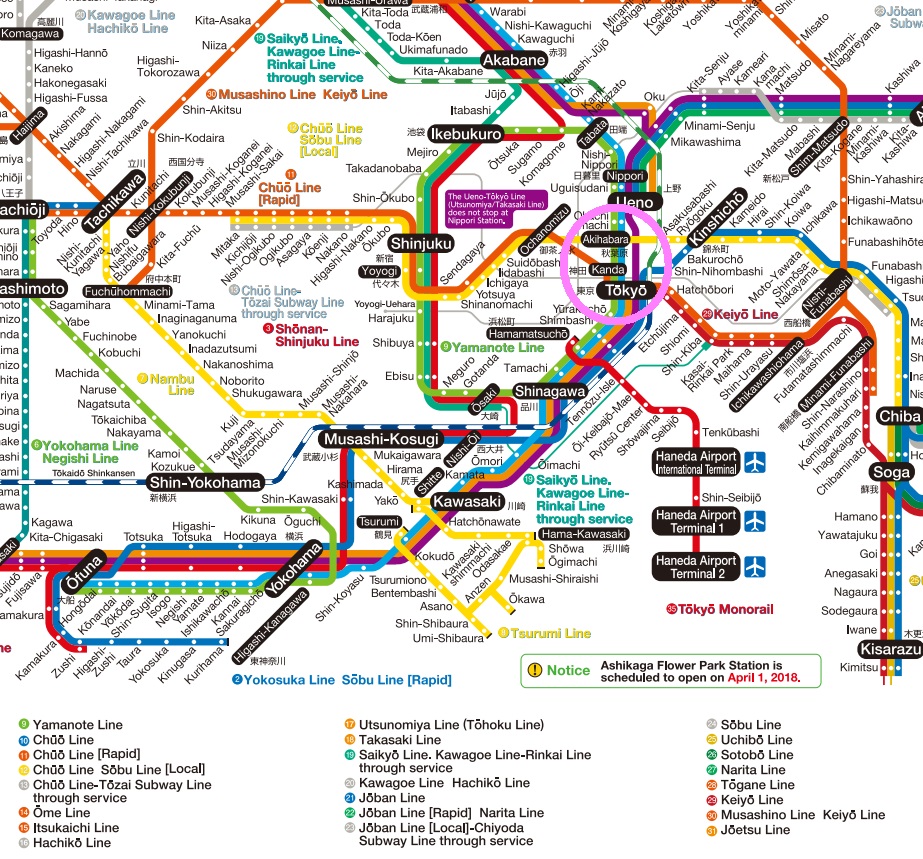
5) Take either line and get off at Tokyo Station or Akihabara station
6) *If you got off at Tokyo station: Then transfer over to the Chuo Rapid line (orange line) and then wait a couple stops to get off at Shinjuku *If you got off at Akuhabara station: Then transfer to the Chuo/Sobu Line (darker yellow line) and wait more stops to get to Shinjuku
Metro gets you to other areas not available by JR Rail
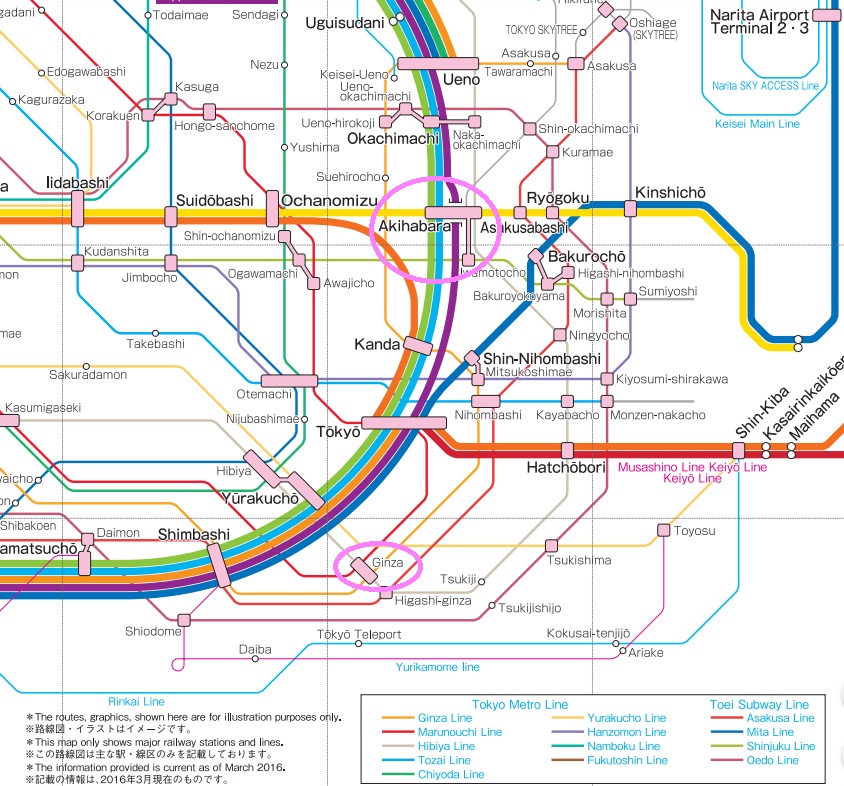
Like the JR map, you will will see a bunch of lines but
FOCUS MAINLY ON THIN COLORED LINES
Every colored
line is a different metro line (for example the darker yellow line is the
Chuo/Sobu line)
Every pink block
is a metro station (often near a main JR station)
Every white dot
is a smaller station that each line stops at
Let’s do an example:
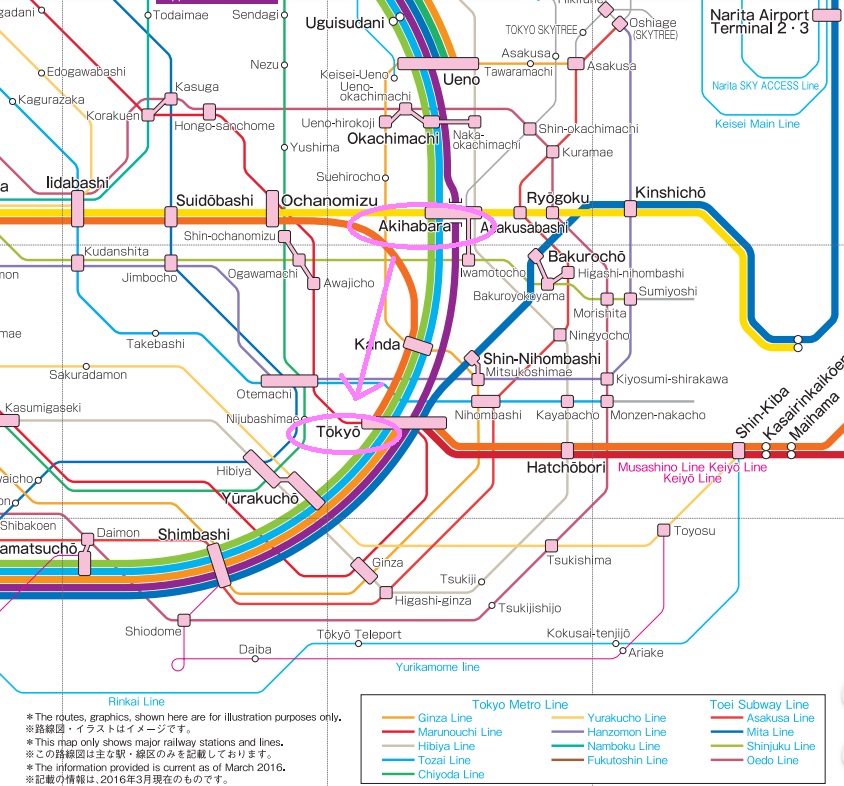
Let’s pretend you want to get from Akihabara to Ginza station!
1) Start by following the
lines, you will start at Akihabara (you will notice that there are no thin
lines getting you to ginza directly)
2) From Akihabara, take the JR Yamanote line (light green), Keihin Tohoku Line (light blue) to TOKYO STATION
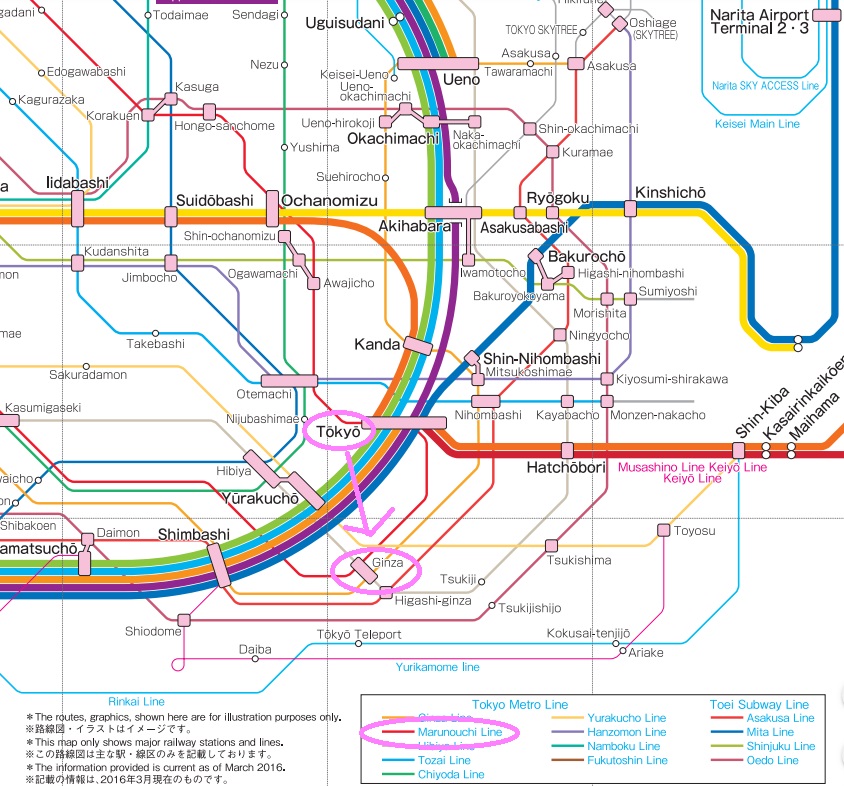
3) From Tokyo JR station, you will leave the station and take the stairs down to the marunouchi metro line
4) From the Marunochi line,
you will get off at Ginza Station
That’s it!
NOTES
JR stations are above ground (often indicated by the color GREEN)
Metro stations are under
ground (often indicated by the color BLUE)
Look for these signs when traveling
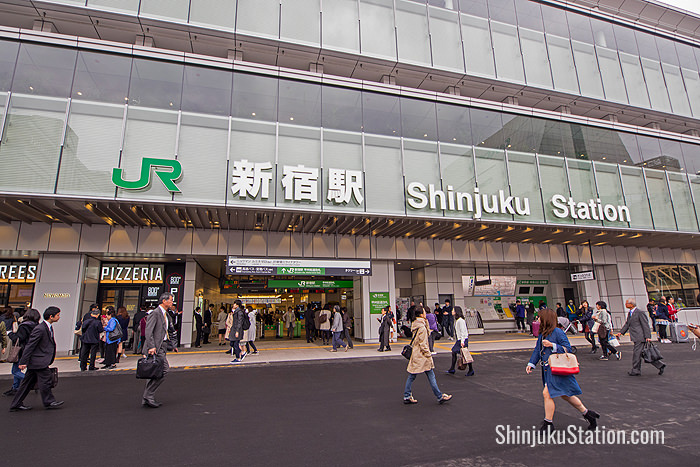
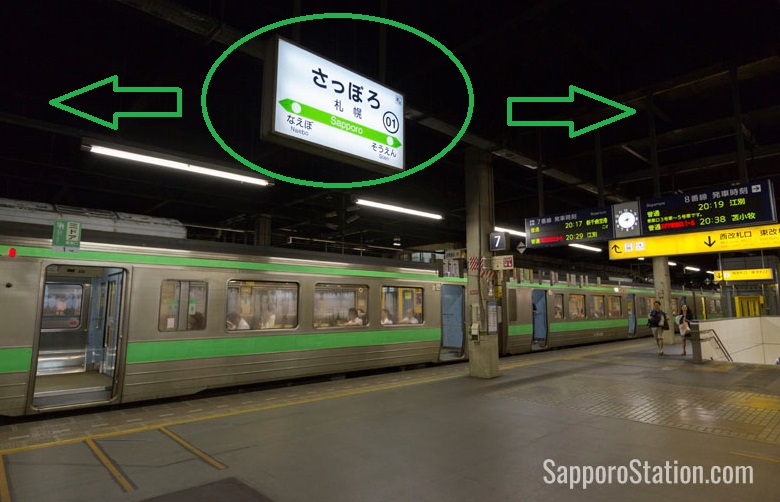
To make sure you are riding in the right direction
There will be signs above the trains like this and the direction train coming is the direction it is going. So you know if you are going the right way by looking on the map and seeing the subsequent stops (if you are going the wrong way, do not panic, get off, and retake the same line in the other direction).
When you activate your JR pass at a JR office at a station,
you can now use any JR system of transport for free!
Normal JR trains: at each station you just need to go through the manned kiosk at the entrance. Show the agent your JR pass and go through (you may do this as many times as you want until your pass expires)
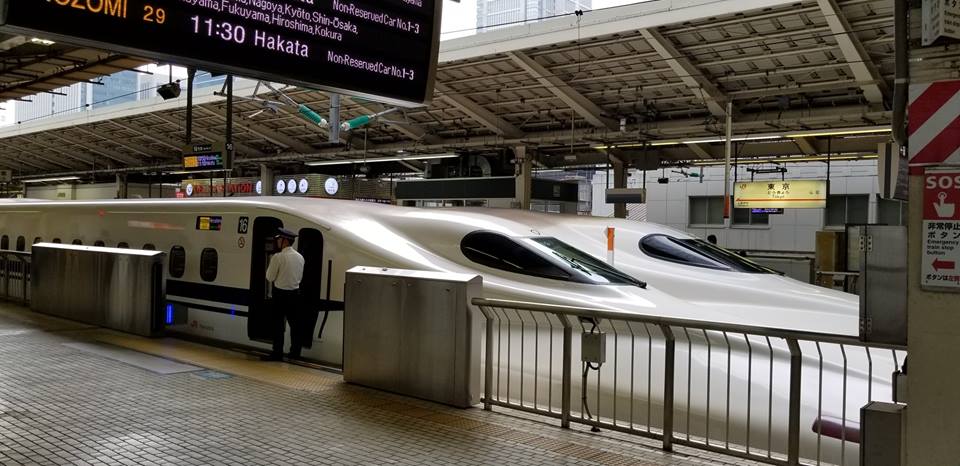
Shinkansen (bullet train): to reserve a spot on a shinkansen with your JR pass, walk into any JR service office and tell them you want to reserve a seat from XXX to XXX station. You will need to show them your JR pass. You will be handed tickets for the train. DO NOT LOSE THEM!
Pay attention to which train you need to get on for example (Hikari train)
There will be a display board throughout the station that shows you which train is at which platform and at what time.
Your ticket will show which platform you need to be at as well.
DO NOT TAKE NOZUMI trains. These trains are specifically for locals who need to get from one place to another quickly. If you get on these trains, you will be charged a ticket.
If you are at your platform early, multiple trains will dock at your platform before yours. Do not get on unless you know it is your train. Trains in Japan are usually ‘on the dot’ with timing and leaves on time
There is an oversize luggage storage space on the trains if needed otherwise, there is usually enough room to have smaller luggage with you as you sit
Yes, your ticket will be checked by an agent on the shinkansen to make sure you are on the right train and in the right seat!
Also pay attention to stops and don’t miss it. Since these trains leave on time, you need to get out promptly.
JR Rail and Metro lines without JR pass
Paying as you go option:
At each station there is a kiosk for you to use
to pay for your transport
There is an English option at each kiosk (I don’t
think there is one without it nowadays in the bigger cities)
Pick your next destination and put in your
cash/coins to pay
A ticket will be dispensed (don’t lose it!)
Go to the gates and put your ticket into the
slot on the right
Your ticket will come out on the other side.
GRAB IT!- you need it to get out
Get to your train and queue in with everyone (if
you miss it, you can always for the next one, they come often)
Get off the train at your stop (if you get off
at the wrong stop- wait for the return train and get off at the correct stop)
Pick an exit and use your ticket again by
placing it in the slot (you CANNOT use your ticket to get off at another stop
other than the one you picked)
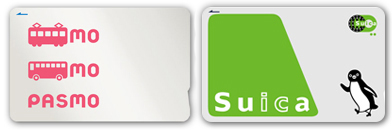
Paying with a card (Suica or Pasmo):
At each station there is a kiosk for you to use to pay for your transport
There is an English option at each kiosk
There will be an option to get a suica or pasmo card
Pick either option (I always pick suica)
Then deposit how much money you picked to be on the card
Fill out any other information you may want to put on the card like name, etc.
Then a card will dispense when you are done
Use this card for either metro or JR line. (You can also use this card for vending machines, certain buses, and more)
Go to a gate and tap on the reader on the right of the gate
Follow procedures to riding the train and getting off as explained above
When exiting a station- tap the reader again and your card will automatically be charged the distance traveled (same amount if you paid for a ticket)
BIGGEST MISTAKE!!!!!! YOU CANNOT GET IN AND OUT OF THE SAME STATION USING A CARD. You will be flagged and someone has to come and help you reset your card. So be sure you want to get into that station especially if you are transferring between metro and JR.
If you need to refill your card, there are kiosks inside and outside the gate.
Using the English option, follow instructions and place your card in the kiosk slot, then refill how much money you want on there
Pros and Cons of either paying method
Suica or Pasmo:
Pros- you don’t have to worry about using the kiosk every time you want to go somewhere, just tap and go. Also the cards could also be used like a debit card in other stores, machines, etc.
Cons- you may put too much on your card by the time you leave. That money cannot be exchanged into cash for you to get back (or at least not that I know of)
Pay as you go:
Pros- You reduce the chance of having left over yen in a card
Cons- Takes way more time especially if you are moving around a lot. Also you can possibly lose your ticket.
In the next blog, I will break down how to read transportation maps!
No matter which airport you land in Japan, you will have to go through customs/immigration
When you get off the plane, follow the crowd towards customs/immigration (will be in English).
You can get a visitor/immigration card on your plane and fill it out during flight, or you can fill one out at a kiosk/desk near the immigration area
Follow signs that fit your status (Japanese passport holders, visitor, etc.)
Follow instructions from your immigration agent (you will be fingerprinted and photographed)
You will get your luggage after customs
Follow the exit and look at signs above to see where your luggage will be
After you grab your luggage, you will go through customs to make sure you didn’t bring anything illegal into the country
You will answer questions about where you are staying, why, etc.
I have told them before that I am staying in a hotel in Tokyo (which I wasn’t until the 3rd day) and left it at that. They did not search my bag or anything.
Then you are free to go to the main center of the airport
Once you’re at the main airport lobby: pick up any sim cards/phones, exchange money, activate JR pass, and do what needs to be done before leaving the airport. There will be people around that can help you find your way to pick up locations, money exchange, transportation, etc..
You can also deliver your luggage to your destination- You can find services like these at many airports
The Rapid Sobu Line is a normal non-reserved JR train to Tokyo. There are more stops on this line and more people. It can be very crowded at certain times of the day.
















 Travel Japan 101